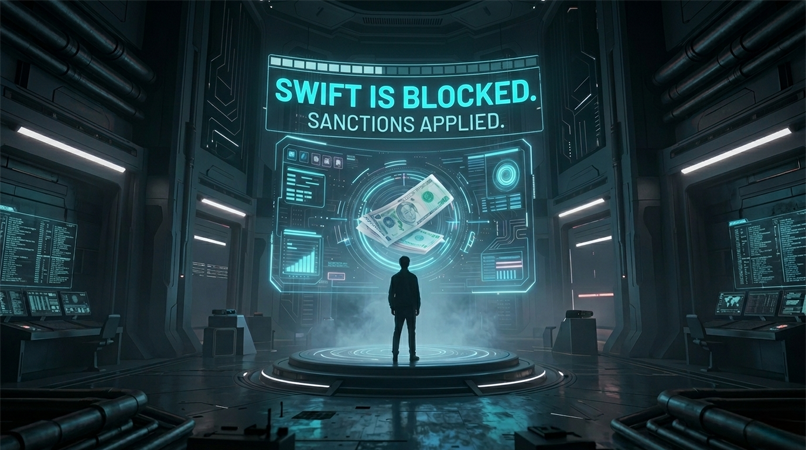
If you’re trying to move capital across borders and the "gold standard"—SWIFT—is off the table due to sanctions, regional instability, or simply excessive bureaucracy, you aren't stuck. The plumbing of money is being re-routed.
Here is a deep dive into how international deals are actually happening right now when the traditional lights go out.
While SWIFT is the most famous messaging system, it’s not the only one. Countries facing isolation have built their own "rails."
| System | Primary Currency | Governance | Speed |
|---|---|---|---|
| SWIFT | USD/EUR/Multi | Global Consortium | 1–5 Days |
| CIPS | CNY | People's Bank of China | Near Instant |
| SPFS | RUB | Central Bank of Russia | Instant (Domestic) |
| Digital Ledger (DLT) | Stablecoins/BTC | Decentralized | Minutes |
For a practical deal, you don't care about "HODLing." You care about liquidity and finality.
The most common "real-world" workaround involves USDT (Tether) or USDC, specifically on the TRON (TRC-20) or Polygon networks because fees are negligible ($1–$2) compared to Ethereum’s gas spikes.
The Practical Workflow:
Pro-Tip: If you're worried about "tainted" coins (tokens linked to illicit activity), use tools like Chainalysis or AMLBot to check the wallet history before accepting funds. Clean liquidity is worth a 1-2% premium.
Long before the internet, there was Hawala. It’s a trust-based system used extensively in the Middle East, South Asia, and parts of Africa.
When currency is the problem, stop using currency. We’re seeing a massive resurgence in Barter 2.0.
Example: A company in Ukraine needs specialized hardware from India. The Indian supplier needs agricultural raw materials. Instead of two SWIFT transactions, the companies perform a "Value Swap."
The Technical Detail: This is often managed via Back-to-Back LCs (Letters of Credit) issued by local banks that have a direct bilateral relationship, bypassing the Western intermediary correspondent banks.
Even if you bypass SWIFT, you aren't invisible.
When direct payments are blocked, payment agents step in. These aren't just fixers; they are full legal entities in "friendly" or neutral jurisdictions.
The Deal Mechanics:
The Catch: This isn't charity. Agent commissions for "routing" funds currently swing between 3% and 7% depending on the region's complexity and the "toxicity" of the goods. The main risk? KYC (Know Your Customer). The agent’s bank might freeze the payment if they sniff out a sanctioned end-beneficiary.
In a world without SWIFT, the biggest hurdle isn't the tech—it's trust. If you're sending USDT to a supplier you’ve only met on Zoom, you have zero protection. This is where specialized services like EXMON Escrow become the backbone of the deal.
How it works: It acts as a neutral third-party guarantor. The buyer deposits the funds into the escrow system. The seller sees the funds are secured and verified, then ships the goods.
Release of Funds: Money is only released to the seller once the buyer confirms receipt or the terms of the deal are met.
The Fee Structure: Unlike an exchange, there are no "makers" or "takers" here. You pay a transparent service commission for the security of the transaction, which is still significantly cheaper and faster than a traditional bank's Letter of Credit (LC).
Dispute Resolution: If the goods show up damaged or don't match the specs, the escrow service holds the funds in "stasis" until an arbiter resolves the issue.
A more "pro" method gaining traction is Real World Assets (RWA) tokenization. Instead of moving money, you move the legal right to the asset.
The Workflow: A cargo (e.g., grain or specialized parts) is tokenized on a blockchain. A smart contract issues tokens backed by a digital warehouse receipt.
The Trade: You swap tokens for stablecoins. The buyer presents the tokens at the destination to claim the physical goods.
The Result: The financial flow is completely decoupled from the logistics. Banks see the movement of goods, but the actual "payment" happens on-chain, invisible to traditional sensors.
For those on the technical side, you need to know how to turn "digital gold" into local cash for operational expenses without triggering every red flag in the building.
Many firms use P2P (Peer-to-Peer) networks not for trading, but for payroll or small-batch procurement.
The Flow: A company buys USDT via a corporate account, then distributes it to local wallets. These are then converted to local currency via P2P orders to cover local costs.
| Pros | Cons |
|---|---|
| Bypasses currency control boards | Risk of personal card blocks (AML laws) |
| 15–20 minute settlement | Higher spreads than direct market |
| High sender anonymity | Limits on single transaction volumes |
If you are running the deal in crypto, stop looking at screenshots. They are easily faked. Use a Blockchain Explorer.
Before considering a deal "closed," verify:
Working without SWIFT is stressful. When you tell a partner, "I'll pay you in USDT via an escrow," you'll face skepticism.
Before hitting "Send" on a multi-million dollar bypass:
The world is bigger than SWIFT. As long as there is trade, money will find its way through. You just need to know which pipes are currently open.